In this post, I'll be discussing Critical Distance extensively. For those unaware, Critical Distance is a website that promotes, aggregates, and solicits video game criticism. It is crowd funded, and I have at various times supported it monetarily.
A few weeks ago, Zoya Street concluded Critical Distance's weekly "This Week in Videogame Blogging" feature (retrieved 2016-08-19) with a question: "how do you see the current state of games criticism?" I don't know if anyone else responded, because it hasn't shown up again since then in the weekly posts. In any case, in this post, I'd like to highlight what I personally see as the most distinguishing feature of video games criticism. Street asked for one or two sentences, so here's my attempt: "Video game criticism is poorly preserved and rapidly being lost, and this problem is compounded by the absence of any way to efficiently index or search existing criticism. Critical Distance is currently the best-positioned entity to address this problem, but it has not yet made any meaningful progress in that direction." That's the summary, but I'll spend the rest of this post elaborating.
Critical Distance has on numerous occasions highlighted writers that discuss the urgent problem of preserving the history of games, but the focus of such statements has largely been on (the very important) software and hardware preservation. Among many others, Kris Graft has written about the emulation efforts of the Internet Archive (retrieved 2016-08-19), and Gita Jackson reacted (retrieved 2016-08-19) to the loss of P.T. (dev. 7780s Studio, dirs. Hideo Kojima & Guillermo del Toro, 2014). That latter article is particularly instructive because it makes an analogy to silent film. It rightly recognizes that games have something to learn from how so many silent films were lost in the early years of cinema's history. the film industry eventually learned its lesson and stopped destroying every copy of most of its films once the cultural importance of the medium began to be understood in more depth. As film grew up, the dialogue with critics was often quite important. Perhaps the most famous examples of this dialogue are the early Soviet montage essays or, decades later, the founding of the seminal Cahiers du cinéma magazine in 1951. Film history and our understanding of the function of film was shaped by these and many other critics. By default, because film grew up in the pre-digital era, these writings were not destroyed by link-rot or unpaid server fees. Their longevity, both in terms of their physical persistence and their critical importance, is attested to by just how common they remain today. The textbook assigned to me in my first ever introductory film class way back in college was Leo Braudy's and Marshall Cohen's classic anthology of historical film criticism, Film Theory and Criticism, now in its eighth edition.
Video game criticism is not published in state-sponsored tracts or a widely distributed French magazine; it is published on the internet. One need not delve very far into Critical Distance's archive of blog roundups to begin to find dead links or links with dead links within them. If one is lucky, one might find the article somewhere on the Internet Archive's Wayback Machine in varying states of completeness. Though I have no way of knowing the statistics for sure, I imagine that less popular articles that did not enjoy the signal-boosting of a Critical Distance plug are even more likely to be inaccessible. The critical history of video games is being lost.
But do we even know which history of video games is being lost? For that matter, can we even reliably and comprehensively find niche criticism that is still accessible? Critical Distance's Patreon page (retrieved 2016-08-19) points out that it is a great "starting place," and it is. I often do a quick search there for for playing or writing about a game, to see what people have said about it. Critical Distance, however, is curated; it is a thin slice of the video game criticism that the world produces. That's great for a research starting place or for a weekly roundup to keep your readers current, but it is insufficient for in-depth research or preservation purposes. We need something more before we have lost so much that we can't even tell what was lost. The Patreon page alludes to archival projects, but they are ill-defined and certainly haven't happened yet. The proposed print anthologies, an even thinner and more easily lost slice of the criticism landscape, certainly aren't the solution.
The solution is two-fold. First, games criticism needs an uncurated (but still moderated), searchable index. Professionally, I am an astrophysicist, so I spend a great deal of my time browsing and searching the astronomy and physics literature. The astronomy academic community has two main tools to browsing the literature: arXiv (pronounced AR-kive - the "X" is a Greek "Chi") and the Astrophysics Data System (ADS). Though there are more differences than similarities, in some ways, arXiv is analogous to Critical Distance. Researchers post freely-accessible preprints of their papers there, and other researchers browse them daily to see what's new. A digest gets sent out via email. ADS, however, fills a very different niche. It is a searchable, tagged index of the published (and some unpublished) literature in astronomy, physics, geophysics, and science education. For older literature, it also serves as a historical index of scanned pages. Using ADS, one can quickly find nearly anything that has ever been published in these fields based on nearly any criteria. ADS was one of the first such data systems and its colossal importance to research is well studied (there's even a summary on Wikipedia, retrieved 2016-08-19). Games criticism needs something analogous to ADS. There needs to be a way to search and filter more than just was is featured on the Critical Distance homepage. The database could be implemented as a web crawl of known likely sources of criticism that also allows manual submission to the database.
Second, games criticism needs that searchable index to double as an archive. It needs to mirror lost webpages (when those webpages don't prohibit archiving via the well-defined methods for doing so). Ideally, the index itself would serve as the mirror, but other possible solutions exist, such as a collaboration with the Internet Archive to automatically make a Wayback Machine clone upon addition to the database, a feat that could be quickly implemented with a simple script that uses the Wayback Machine's API. Even if such an index database was never created, this solution could be easily implemented for every link ever posted on Critical Distance with a single Python/Perl/whatever script that either downloaded a copy of each link or queried the Wayback Machine to make a clone. Links to these backups could be automatically used to replace dead links throughout Critical Distance via another script, assuming that Critical Distance's current backend doesn't prevent doing so. None of these procedures should be undertaken manually, however, as that is an unsustainable approach. A series of server-side scripts should be used to manage these projects.
The solution to preserving games criticism requires both simple and difficult, expensive steps. It is not out of reach at the present time to archive, simply and automatically, all criticism referenced on Critical Distance. Is is substantially more difficult to create a long lasting, searchable index. These efforts will never be an exciting project that galvanizes the community, and half measures will not suffice in the long term. If we care about preserving games criticism, however, there is little choice; these are necessary steps, and they require careful planning with community involvement. I am not involved with the running of Critical Distance, but it seems to be a natural place to host these projects. In lieu of that, I hope that some enterprising website, university, or library one day decides to tackle this little-publicized problem.

on Thursday, October 22, 2015
- Developer: Nintendo EAD
- Directors: Takashi Tezuka, Toshihiko Nakago, Shigefumi Hino, Hideki Konno
- Original Release: 1995-08 (JP), 1995-10 (NA, EU)
- Version Notes: This post refers to the original North American SNES release played on a Windows 7 PC via the bsnes emulator (64-bit version 088; new releases use the name "higan"). Xbox360 controller mapped as closely to the SNES controller as possible was used. No video filters used. "Blur" video shader, Direct3D, DirectSound, and RawInput were used.

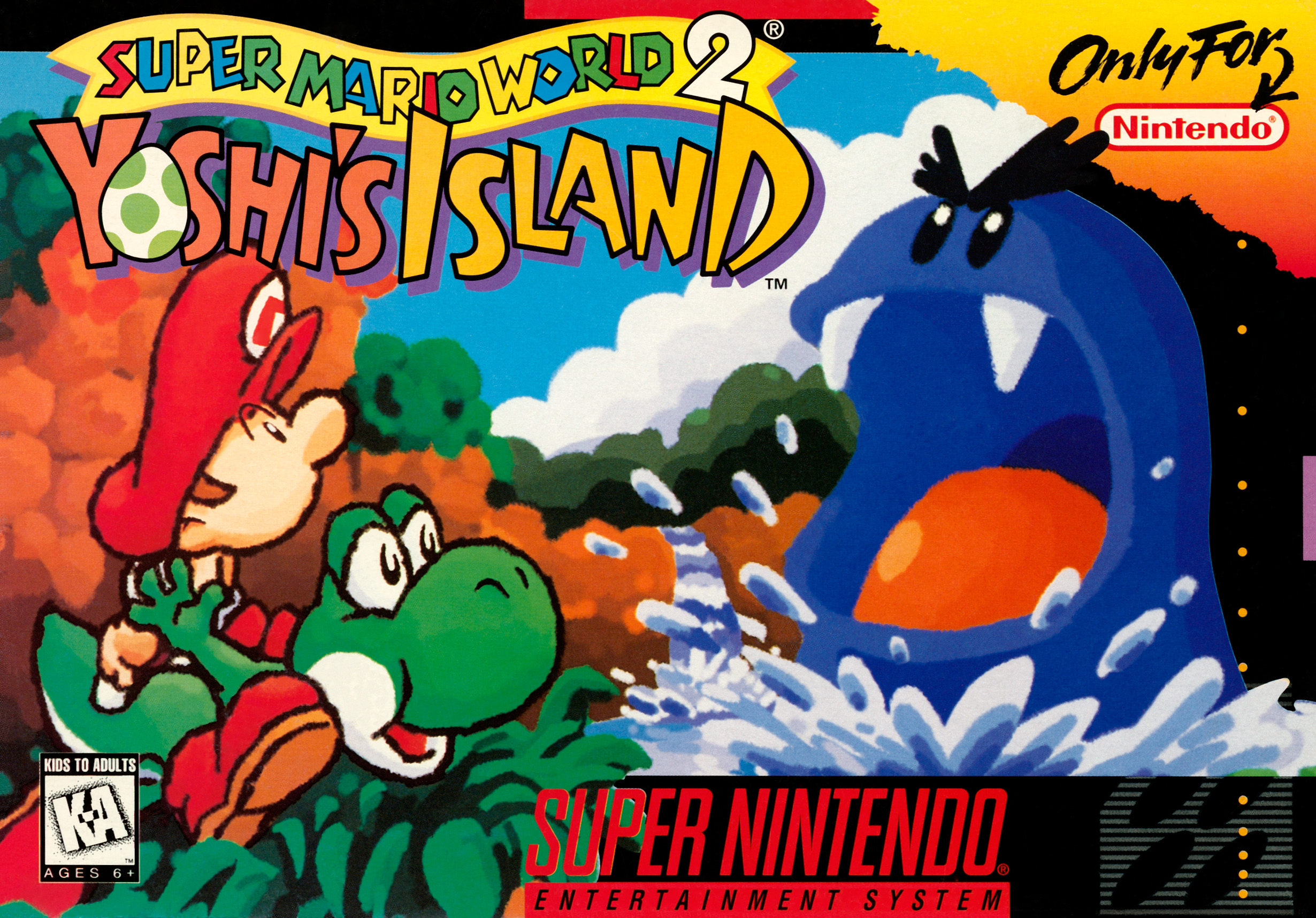
By the time Super Mario World 2: Yoshi's Island was released for the Super Nintendo Entertainment System (SNES) to Western markets in October, 1995, both the Sega Saturn and the Sony Playstation (as well as the minor players, the 3DO and Atari Jaguar) had already ushered in the fifth generation of home consoles. With the new generation came the dominance of 3D polygonal games on home consoles, supplanting the sprite-based 2D games that had previously dominated the market. Development of games that use these polygonal 3D spaces is fundamentally different from 2D sprite-based development in many ways. In this post, I will focus on the increased importance of graphical asset deformation as a mode of animation, in contrast to the more frame-based animation of many 2D games of the SNES era. Yoshi's Island, perhaps influenced by the growing 3D development market, implements many of these deformative techniques in its game design, making it one of the most experimental 2D, Nintendo platformers on the SNES. The function of these aspects of its design are likely major aspects of the game's critical success.
Most platformers, and indeed most games, on the SNES achieved animation by moving 2D sprite images relative to each other. Each of these sprites could have multiple frames of animation itself, with the color and location of each pixel in each frame rigidly defined. This approach was prevalent partially due to the SNES hardware, which was practically incapable of rendering complex 3D worlds or even of rotating, scaling, or deforming 2D sprites in-game. The few games that attempted to do something differently usually had to do so through careful sprite-based trickery. Super Mario Kart (dev. Nintendo EAD, dirs. Tadashi Sugiyama & Hideki Konno, 1992), for example, used a clever combination of the Mode 7 (retrieved 2015-10-14) graphical mode and changing kart sprite size to give the impression of distance in a 3D world. Even the changing sprite size, however, was not done on-the-fly in the game; instead, the developers created the illusion of sprite scaling by swapping sprites of different sizes in and out of the display. (And even this false-3D world required an additional piece of hardware - the DSP-1 chip - on the game's cartridge.) These hardware constraints naturally informed the sorts of game design that could be accomplished on the SNES, and the restrictions imposed by such mostly-static, sprite-based design can be seen in the myriad 2D platformers released for the system. (There were exceptions of course: Clever software rendering on only the native SNES hardware allowed alternate approaches by a handful of games, such as Wolfenstein 3D [devs. id Software & Imagineer Co. Ltd., 1994], which managed a pseudo-3D first person shooter.)
In time, developers sought to expand the SNES's hardware capabilities by including additional processing power on the game cartridges themselves. Perhaps the most famous of these coprocessor chips were the Super FX and its successor, the Super FX 2. Nearly all of the games that used these Super FX coprocessors attempted to use the aging SNES to compete with the next generation of game consoles by creating games in 3D. However, these early attempts at 3D games on the SNES were simplistic; though they managed to capture some simple thrills of flight or racing, they could not explore the promise of 3D for game design in any real depth. Ultimately, these attempts at bringing 3D to the SNES were a dead end from a game design perspective. The one Super FX title that attempted something different with the additional power afforded by the Super FX 2 was Yoshi's Island. It deploys its coprocessor to expand the possibilities of 2D platforming, and as a result it ventured into more creative and experimental game design. The principles that it explores are ultimately closer relatives of later 3D game design than any of its 3D Super FX cousins.
Yoshi's Island is superficially quite similar to its predecessors in the Mario series. Its most obvious departures - the crayon-like art style and the Yoshi-protecting-Mario mechanic - have been amply discussed elsewhere, so I won't dwell on them here. Instead, let's consider how the game leverages the capabilities of the Super FX 2. Throughout the levels, numerous obstacles - including a few polygonal ones - are maneuvered in interesting ways. However, I want to focus on how the design of boss battles has evolved in this game compared to its predecessors, and how those techniques relate to more modern game design perspectives.
A game that takes place in a 3D world has a vastly larger number of possible positions and movements for its assets and camera than one that takes place in a 2D world. This feature precludes any possibility of planning the graphics pixel-by-pixel, as had been done in many sprite-based 2D games. Instead, 3D graphical assets are defined and then deformed, such as into a walk cycle, before the resultant pixels are calculated and rendered to the screen. This approach accommodates a flexibility of design in which a greater variety of player actions can be accommodated. Despite taking place in 2D, many of the boss battles in Yoshi's Island take similar approaches, something that previous Mario games could not do owing to hardware limitations. Where past Mario bosses typically required the dodging of patterned obstacles while trying to jump on the boss's particular weak spot, Yoshi's Island's bosses create variety that encourages critical thinking and dynamic attack strategy while maintaining excitement through the combination of this diversity and stylized graphics. These boss battles control player movement and positioning dynamically by using very large sprites, they allow a diverse set of positions and angles from which the player can attack via deformations and rotations, and they heighten tension during the battles by creating depth via dynamic sprite scaling. Let's look at several examples.
 |
| Sluggy the Unshaven deforming in response to an egg throw. |
 |
| Raphael the Raven's battle on a planetesimal, made possible by liberal use of sprite rotation. |
 |
| Baby Bowser looming in the background, inching forward. |
These battles, and others like them, set the tone of the game as a whole. Yoshi's Island encourages experimentation in strategy on the part of the player by continually subverting the player's expectations of what will be required of them in a Mario game. The game is only able to make this design work because it adopts the sprite-deformation techniques enabled by the Super FX 2 and perhaps informed by the burgeoning 3D game design industry. In this sense, Yoshi's Island is the first truly modern Mario game in game design sense, as it, for the first time, has full control of its graphical assets and can deploy them against its themes. The small segments inform the whole, exploring the mechanics in greater and more experimental depth that had been achieved before.
Despite the critical acclaim that Super Mario World 2: Yoshi's Island and its re-releases received, there has been little critical discussion of how it is mechanically distinct from its predecessors owing to its hardware. Indeed, the word "Yoshi" has never even been mentioned on Critical Distance (retrieved 2015-10-16), despite the game's enduring legacy, both in terms of the sequels it spawned and the impact it likely had on future Nintendo game designs. Instead, it has become lost in the sea of Mario games, and what few consumer-guide-oriented reviews exist for the title largely focus only on surface-level discussions of the presence of an infant Mario character and the crayon-styled graphical assets. Such neglect of any deeper criticism is a shame, because while some aspects of its level design had become run-of-the-mill by the time of its release, other aspects, such as those discussed here, were truly remarkable for their subtle innovations.
on Wednesday, September 16, 2015
This "Notes on Morrowind" series of posts will be brief remarks on small topics related to The Elder Scrolls III: Morrowind Game of the Year Edition
(dev. Bethesda Softworks, dirs. Todd Howard & Ken Rolston, 2003 [original game release 2002])
for PC rather than a holistic game analysis. All posts refer to the unmodded, version 1.6.1820 of the game played with maximum graphical and AI quality settings, a 1280x960 resolution, and all other settings at their defaults.
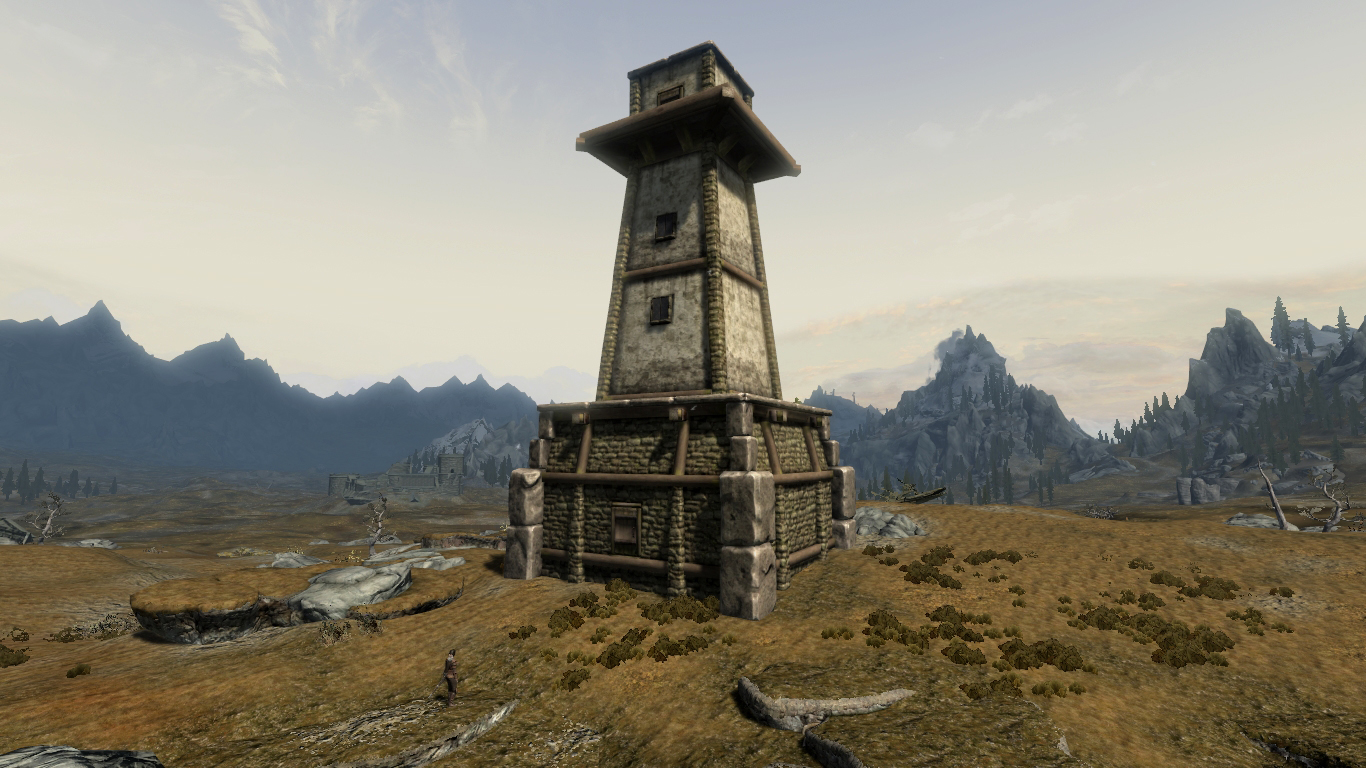
The Elder Scrolls series has prompted the creation of thousands of user-made game modifications ("mods"), and this community-driven development has become so prominent that it has become a major identifier for the franchise and selling point for the PC editions of the games. One of the more notable collections of mods are those by the TES Renewal Project (retrieved 2015-03-17). This team produces mods that recreate older Elder Scrolls games within the game engines of relatively newer Elder Scrolls games. For example, they host (although they didn't originally create) "Morroblivion," a mod that attempts to recreate Morrowind within the game engine of The Elder Scrolls IV: Oblivion. "Skywind," which is under active development, attempts to recreate Morrowind within the game engine of The Elder Scrolls V: Skyrim.
 |
| The off-kilter Seyda Need lighthouse. |
 |
| Interior bracing of lighthouse. |
 |
| Imperial buildings near lighthouse. |
 |
| Dunmer shacks near lighthouse. |
 |
| Close-up of lighthouse fire. |
 |
| Alternate view of lighthouse. |
 |
| Alternate view of lighthouse. |
on Wednesday, May 20, 2015
This "Notes on Morrowind" series of posts will be brief remarks on small topics related to The Elder Scrolls III: Morrowind Game of the Year Edition
(dev. Bethesda Softworks, dirs. Todd Howard & Ken Rolston, 2003 [original game release 2002])
for PC rather than a holistic or fully-researched game analysis. All posts refer to the unmodded, version 1.6.1820 of the game played with maximum graphical and AI quality settings, a 1280x960 resolution, and all other settings at their defaults.
 | |
| Citizens disbelieve even very recent history. |
Much of the presentation of the game world suggests a static nature of time. NPCs are primarily unmoving, always to be found at the same locations, always willing to give the same responses as if you had never met them before. The land rarely evolves, with no seasons, growing plants, or evident geological processes, though a quest as epic as that of the main quest story must have taken months or years to complete. There is no urgency to any quests, which can be completed at the player's leisure, with the exception of a few that have delays built in to force the player to do other things first.When the main quest stories are all complete, the world still exists just as it was (with a couple few changes to dialog, weather, and enemies), for the player to continue exploring.
 |
| Moons, stars, and clouds move relative to each other. |
Other exceptions include certain locations, such as Holamayan (retrieved 2015-05-20) or the Cavern of the Incarnate (retrieved 2015-05-20), which can only be accessed at dawn or dusk. This again suggests a connection between time and the god-like beings of Morrowind, in this case the major character Azura, because these locations are holy places dedicated to that being. By associating some of the few aspects of the land that are dynamic in time with god-like beings, it suggests the limited scope of history seen by humans in comparison to beings who operate on larger time scales. The predictability of the opening and closing of these locations further associates them with prophecy, suggesting its validity within the game world when it is originating from reliable characters like Azura (and this in turn suggests her reliability).
The final major time-sensitive aspect of the game is construction. The construction of a handful of buildings and other structures can be triggered if the player undertakes certain quests. These structures include the Great House strongholds (retrieved 2015-05-20), the Shrine of Boethiah (retrieved 2015-05-20), and the Raven Rock colony (retrieved 2015-05-20). Notably, these building projects are one of the few ways that the player can directly impact the physical layout of the land in Morrowind, whether by choosing which quests to complete or by making actual construction decisions in the case of Raven Rock quests. However, construction of the projects does not proceed in real time. Upon initiating a construction project, the land and building change in phases, moving from no progress to discrete levels of construction in quantized leaps forward. This progress always occurs when the player cannot see the building site, giving a slight illusion of time continuity. Taken in context with game's themes of memory's interplay with history, this phenomenon seems to be an embodiment of people's tendency to remember things in terms of discrete, important moments leading to important events that changed history, rather than being able to simultaneously perceive the ensemble of small, continuous events that lead to change. The players view of construction is distorted and artificially discrete, and this warping of perception reflects the distorted perspective of the history of the region that the player encounters in books and conversations throughout the game. (The discreteness of the player's journal entries also serves this purpose.)
Straddling the seemingly conflicting themes of static time and moving time are the minor enemies, such as animals, that populate the game world. The player can clear an area of these enemies, and for a time, that area will be safe. Eventually, however, the enemies will respawn and repopulate the region. The player's efforts to eliminate the enemies are thus nullified on larger timescales than a typical play session, suggesting the difficulty of enacting lasting change on the game world and relative equivalence of different points in history. This contrasts with how the game treats NPCs from intelligent species. There, the game enforces the permanence of actions, removing the character entirely if the character is killed and potentially removing the ability of the player to access certain quests and items. Because this seems to occur only with intelligent characters, it suggests an importance that lasts in time to decisions that the game deems moral decisions.
Taken as a whole, the odd way that Morrowind presents time dually, as static and flowing, couples with its narrative emphasis on history and prophecy in interesting ways. The player is made to observe the difficulty of trying to enact lasting change on the world, which lends weight to the main quest's narrative. The player is made to understand that the faulty ways that time and history are remembered has made the player's understanding of the narrative suspect, and whatever the player achieves within the narrative will be, inevitably, misunderstood and misremembered by the future inhabitants of the game's setting. How all of this relates to prophecy is left unclear, perhaps because the player's perspective is too limited compared to beings such as Azura. Though many of these time-related aspects of the game's mechanics are likely related to limitations of the technologies upon which the game was built, their integration with games themes plays a large role in the success of Morrowind.
on Tuesday, March 17, 2015
In academic writing, citations of books, articles, films, and even webpages are usually fairly precise. Printed media is referred to by specific printing or edition, while webpages are usually specified by both URL and retrieval date (though the archiving of webpages is still an area in need of improvement). Most publications with electronic editions, such as academic journals, are even completely uniquely identified by their digital object identifier (DOI). Games criticism, too, usually follows these conventions at least moderately well. Peer-reviewed journals, such as Game Studies, usually follow something like APA style for their citations, which is fairly comprehensive in identifying books, articles, and the like. The increasingly-important critical discourse that takes place on blogs and gaming websites is naturally more varied, but usually URLs and book editions are provided.
Strangely, however, games themselves are rarely uniquely specified in citations. Take, for example, the citation guidelines for Game Studies (retrieved 2015-03-15). The most comprehensive possible citation for a game as described in the style guide must follow the format,
The above example of The Elder Scrolls IV: Oblivion is instructive as to why this citation format is a problem. Perhaps the most obvious issue is the lack of a version or platform specification. Naturally, the game varies among platforms for which the game was released, but issues such as patches make the problem far worse. The Unofficial Elder Scrolls Pages identifies (retrieved 2015-03-15) at least six officially release patches for Oblivion. Other potential patches certainly exist, such as versions used internally at Bethesda Game Studios. These patches sometimes make changes that could potentially impact the arguments presented in Martin's article. The behavior of NPCs is modified in some cases, and the level of detail in the rendering of the environment is modified. Surely one could find even more severe examples of software updates having aesthetic consequences, now that many games are released to the public (and written about by critics) while still in early development, thanks to distribution platforms such as Steam's Early Access program.
Beyond just patches, Oblivion, like many games, allowed the player to purchase content that expands the software. Oblivion's most notable such expansion is The Elder Scrolls IV: Shivering Isles, released in 2007. This expansion pack adds a new storyline, an entirely new region of the in-game world, numerous in-game items, many characters, and several tweaks to systems such as the user interface. Although originally released as an expansion, it was also bundled built-in with later editions of Oblivion. As Martin makes no citation to Shivering Isles, we must assume that the experiences he is writing about are based on the un-expanded Oblivion only, although given that he was writing years after the release of Shivering Isles, it seems far more likely that he was actually using one of the more common expanded versions.
Because Martin works at an English university and writes in English, it is perhaps safe to assume that he is referring the the original, English-language, unlocalized editions of Oblivion. If he were corresponding from a different university, however, this might not be obvious. Oblivion has a wide array of localizations, complete with translated text and different voice acting, both of which have aesthetic consequences. This problem can also affect games played in English, as many games, especially Japanese-developed ones, are localized for the Western markets. These games often have even more dramatic departures from their original versions than mere text translation and alternate voice acting. Yakuza 3 (dev. Sega, dir. Daisuke Sato, 2009), for example, saw many of its minigames removed (retrieved 2015-03-17) for Western localizations. Choice of localization can therefore have a substantial impact on the interpretation of a game. Just as criticism of literature would not refer to a translation without being very clear about what is being discussed, games criticism should not be ambiguous about the effects of the localization used by the critic.
We can take this further. Presumably, Martin is discussing only versions of Oblivion released directly through the publisher, 2K Games, but this is not necessarily true of all authors. Many games, including entries to franchises like The Elder Scrolls and The Sims, are heavily dependent on community-made modifications ("mods") to extend or patch the games. The Oblivion section of Nexus Mods (retrieved 2015-03-17) alone hosts over 26,000 mods for that game. These sorts of modifications can have nearly any effect imaginable, ranging from bug fixes to graphical enhancements to complete reworkings of the game. Even something as simple as a change to the graphical engine's rendering distance has a huge aesthetic impact on the player (for an extreme example, consider how a change to the fog distance in a game like Silent Hill (dev. Konami Computer & Entertainment Tokyo, dir. Keiichiro Toyama, 1999) changes the whole feel of the game). It is thus necessary to be very explicit about the mods (or lack thereof) used in preparing a piece of games criticism.
Finally, even the settings used to play the game are important to most pieces of games criticism. Even if a piece of game software is unambiguously identified as the text used for a piece of criticism, it is unlikely that the author of the criticism is referring equally to all possible configuration settings within the game. Except for pieces explicitly discussing particular difficulty settings or the like, this is almost never addressed in games writing. Difficulty setting may change entire characters or accessible levels, audio settings can entirely change the aural information available to the player, and control settings can impact the experience in a wide array of ways. Graphical settings can have a dramatic impact as well. Choice of aspect ratio or field of view settings change composition and framing, while overall graphical fidelity changes the visual information available to the player. These sorts of decisions need to be made explicit when referring to aspects of games.
The above list of variables that need to be represented when citing a game is potentially quite large and complex. Perhaps academic writing needs to move away from exclusively citing games the way that books and articles are cited. An article might address this complexity through the inclusion of a "Games Methods" section that, like a methodology section in a science or social science paper, describes in great detail the methods for obtaining and using the games that are cited. This sort of detail is especially necessary if games criticism is to continue to be useful years after it is written, because the default mode of interaction with a game can change dramatically over time. The Half-Life 2 (dev. Valve Corporation, 2004) of 2004 is not the Half-Life 2 sold on Steam today; today, players are using a version with a dramatically updated game engine that affects the whole experience. Will these subtleties be remembered in fifty years without accurate and comprehensive game citations? The games writing community as a whole, at all levels of formality and professionalism, needs to make a conscious effort to improve the specificity of citations to games.
Strangely, however, games themselves are rarely uniquely specified in citations. Take, for example, the citation guidelines for Game Studies (retrieved 2015-03-15). The most comprehensive possible citation for a game as described in the style guide must follow the format,
Developer. (Year). Title. [Platform], Release City and Country: Publisher, played month day, year, .In practice, many Game Studies papers simplify this style, as in this example from an article by Paul Martin (2011, Game Studies, 11, 3):
Bethesda Game Studios. (2006). The Elder Scrolls IV: Oblivion. 2K Games.I'll use this example throughout this post, but please note that I don't mean to pick on Martin or his excellent paper; I chose this example merely because it cites a game conducive to this discussion. This citation format is woefully inadequate for any critical or academic writing, but it is usually simplified even further outside of peer-review journals. Most game blogs and websites merely mention a game by name and leave it at that.
The above example of The Elder Scrolls IV: Oblivion is instructive as to why this citation format is a problem. Perhaps the most obvious issue is the lack of a version or platform specification. Naturally, the game varies among platforms for which the game was released, but issues such as patches make the problem far worse. The Unofficial Elder Scrolls Pages identifies (retrieved 2015-03-15) at least six officially release patches for Oblivion. Other potential patches certainly exist, such as versions used internally at Bethesda Game Studios. These patches sometimes make changes that could potentially impact the arguments presented in Martin's article. The behavior of NPCs is modified in some cases, and the level of detail in the rendering of the environment is modified. Surely one could find even more severe examples of software updates having aesthetic consequences, now that many games are released to the public (and written about by critics) while still in early development, thanks to distribution platforms such as Steam's Early Access program.
Beyond just patches, Oblivion, like many games, allowed the player to purchase content that expands the software. Oblivion's most notable such expansion is The Elder Scrolls IV: Shivering Isles, released in 2007. This expansion pack adds a new storyline, an entirely new region of the in-game world, numerous in-game items, many characters, and several tweaks to systems such as the user interface. Although originally released as an expansion, it was also bundled built-in with later editions of Oblivion. As Martin makes no citation to Shivering Isles, we must assume that the experiences he is writing about are based on the un-expanded Oblivion only, although given that he was writing years after the release of Shivering Isles, it seems far more likely that he was actually using one of the more common expanded versions.
Because Martin works at an English university and writes in English, it is perhaps safe to assume that he is referring the the original, English-language, unlocalized editions of Oblivion. If he were corresponding from a different university, however, this might not be obvious. Oblivion has a wide array of localizations, complete with translated text and different voice acting, both of which have aesthetic consequences. This problem can also affect games played in English, as many games, especially Japanese-developed ones, are localized for the Western markets. These games often have even more dramatic departures from their original versions than mere text translation and alternate voice acting. Yakuza 3 (dev. Sega, dir. Daisuke Sato, 2009), for example, saw many of its minigames removed (retrieved 2015-03-17) for Western localizations. Choice of localization can therefore have a substantial impact on the interpretation of a game. Just as criticism of literature would not refer to a translation without being very clear about what is being discussed, games criticism should not be ambiguous about the effects of the localization used by the critic.
We can take this further. Presumably, Martin is discussing only versions of Oblivion released directly through the publisher, 2K Games, but this is not necessarily true of all authors. Many games, including entries to franchises like The Elder Scrolls and The Sims, are heavily dependent on community-made modifications ("mods") to extend or patch the games. The Oblivion section of Nexus Mods (retrieved 2015-03-17) alone hosts over 26,000 mods for that game. These sorts of modifications can have nearly any effect imaginable, ranging from bug fixes to graphical enhancements to complete reworkings of the game. Even something as simple as a change to the graphical engine's rendering distance has a huge aesthetic impact on the player (for an extreme example, consider how a change to the fog distance in a game like Silent Hill (dev. Konami Computer & Entertainment Tokyo, dir. Keiichiro Toyama, 1999) changes the whole feel of the game). It is thus necessary to be very explicit about the mods (or lack thereof) used in preparing a piece of games criticism.
Finally, even the settings used to play the game are important to most pieces of games criticism. Even if a piece of game software is unambiguously identified as the text used for a piece of criticism, it is unlikely that the author of the criticism is referring equally to all possible configuration settings within the game. Except for pieces explicitly discussing particular difficulty settings or the like, this is almost never addressed in games writing. Difficulty setting may change entire characters or accessible levels, audio settings can entirely change the aural information available to the player, and control settings can impact the experience in a wide array of ways. Graphical settings can have a dramatic impact as well. Choice of aspect ratio or field of view settings change composition and framing, while overall graphical fidelity changes the visual information available to the player. These sorts of decisions need to be made explicit when referring to aspects of games.
The above list of variables that need to be represented when citing a game is potentially quite large and complex. Perhaps academic writing needs to move away from exclusively citing games the way that books and articles are cited. An article might address this complexity through the inclusion of a "Games Methods" section that, like a methodology section in a science or social science paper, describes in great detail the methods for obtaining and using the games that are cited. This sort of detail is especially necessary if games criticism is to continue to be useful years after it is written, because the default mode of interaction with a game can change dramatically over time. The Half-Life 2 (dev. Valve Corporation, 2004) of 2004 is not the Half-Life 2 sold on Steam today; today, players are using a version with a dramatically updated game engine that affects the whole experience. Will these subtleties be remembered in fifty years without accurate and comprehensive game citations? The games writing community as a whole, at all levels of formality and professionalism, needs to make a conscious effort to improve the specificity of citations to games.
on Monday, March 2, 2015
This blog is now accessible from the top-level domain http://www.thinkingwhileplaying.com. Please update your feeds!
on Monday, October 20, 2014
A while back, I wrote a short review of the scientific results on whether "brain training" games like the Brain Age (devs. Nintendo SDD & Nintendo SPD, various dirs., 2005-2013) series have any cognitive benefits beyond mere entertainment, as their marketing strongly implies. I argued that while it is possible that cognitive decline might be mitigated in certain populations by playing such games, the effect was poorly established and no better (and possibly worse) than other mental exercises, whether they be more traditional activities or any other video game. This question is clearly one that is on the minds of many consumers; search results leading to this post are one of the largest sources of traffic to this blog.
Recently, a group of scientists has issued a statement through the Stanford Center on Longevity that summarizes the current scientific thinking toward such games. The statement, "A Consensus on the Brain Training Industry from the Scientific Community," is available online. It largely agrees with my assessment, arguing that there is no evidence that these games are better than other activities in reducing cognitive decline. It, however, offers new and different citations to the scientific literature that my post did not have access to at the time, and it is written by experts in the field. Please give it a read if you are interested in this topic.
Recently, a group of scientists has issued a statement through the Stanford Center on Longevity that summarizes the current scientific thinking toward such games. The statement, "A Consensus on the Brain Training Industry from the Scientific Community," is available online. It largely agrees with my assessment, arguing that there is no evidence that these games are better than other activities in reducing cognitive decline. It, however, offers new and different citations to the scientific literature that my post did not have access to at the time, and it is written by experts in the field. Please give it a read if you are interested in this topic.
Subscribe to:
Posts (Atom)



 Posts
Posts